Vasyl Cherepanyn – recently appointed curator of the 14th Berlin Biennale for Contemporary Art – in conversation with Igor Stokfiszewski from Krytyka Polityczna
Organizator/ka: Krytyka Polityczna

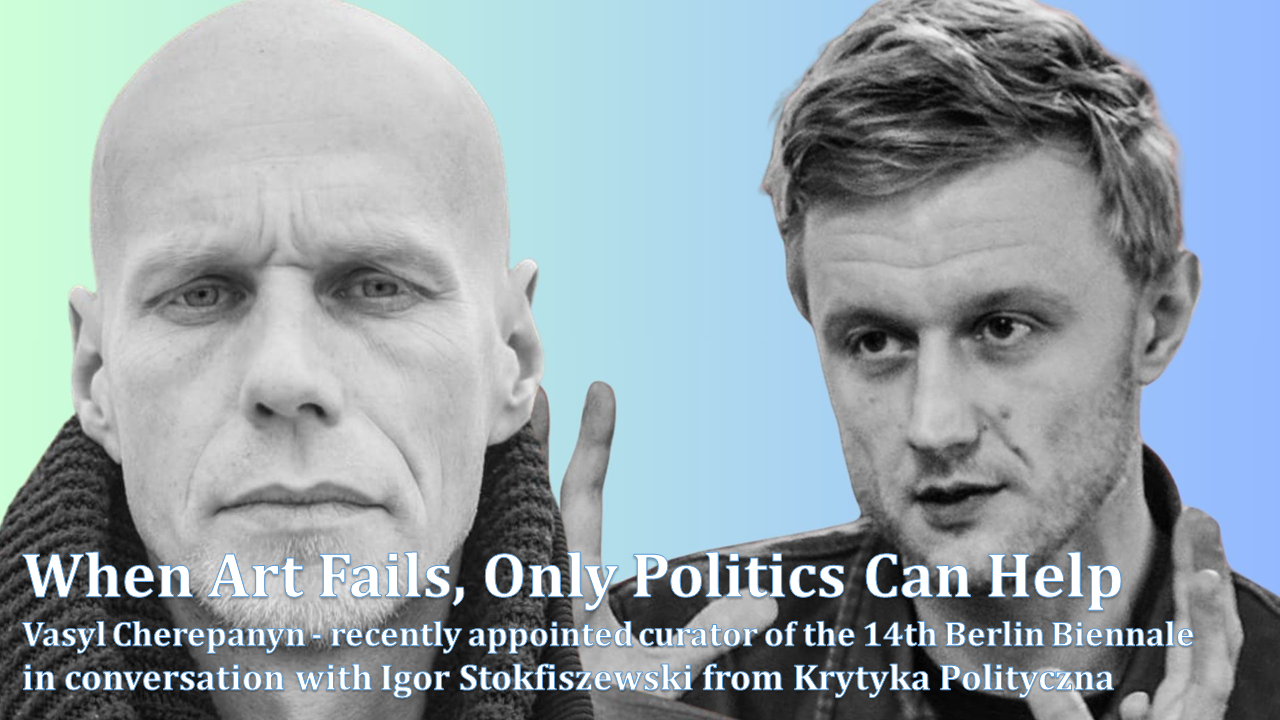
Vasyl Cherepanyn – recently appointed curator of the 14th Berlin Biennale for Contemporary Art – in conversation with Igor Stokfiszewski from Krytyka Polityczna
Organizator/ka: Krytyka Polityczna
When Art Fails, Only Politics Can Help
Vasyl Cherepanyn – recently appointed curator of the 14th Berlin Biennale for Contemporary Art – in conversation with Igor Stokfiszewski from Krytyka Polityczna
The interview is an edited version of excerpts from a video conversation recorded on December 5, 2025. The full recording is available here.
Igor Stokfiszewski: Hello, Vasyl. It’s fantastic to see you. I was so excited that you were appointed curator of the 14th Berlin Biennale, which is going to take place in 2027. How do you feel about the appointment?
Vasyl Cherepanyn: Hi, Igor. Such an outcome was quite surprising for me, to be honest. I actually feel very challenged because it’s a huge responsibility, which I perceive not just personally, but with regards to the Eastern European region. I treat this appointment as a kind of political Zeitenwende (turning point) in German culture [laughs – ed.].
Igor Stokfiszewski: Thank you for finding time, given how busy you are managing both the Berlin Biennale and the ongoing Kyiv Biennial. I want to speak to you about the trajectory which led you to the point where you are now.
Vasyl Cherepanyn: I appreciate your proposal. I value especially this type of dialogue, as we are close colleagues, friends, and comrades. In this regard, I’ve been thinking about the German notion of Zeitgenossen, which means contemporaries – those who are contemporary to each other and literally comrades with time. This talk for me is really about how to be contemporary in a political, fundamentally existential sense. To have a proper navigation and orientation regarding what time we are living in is crucial.
Igor Stokfiszewski: I was also thinking that we could share differences, speak about moments when I was surprised, sometimes even shocked about your political and artistic statements or activities.
Vasyl Cherepanyn: I am especially curious about those differences, which are typical, given the variety of historical backgrounds of our countries, particularly concerning the history of the region after the Second World War.
Igor Stokfiszewski: Absolutely. I wanted to start with a question about the Visual Culture Research Center (VCRC), launched in 2008 as both a part of the National University of Kyiv-Mohyla Academy and an independent cultural center. What was the institutional inspiration or model behind launching the Center?
Vasyl Cherepanyn: In 2008, there was a specific Zeitgeist. We were a bunch of people coming mostly from a cultural studies background. We felt there was a new type of knowledge ready to enter the stage, but there was no institutional place for this intersection of cultural theories and critical social practices within the university curriculum. At the same time, we wanted to save a unique space for contemporary art connected to the former George Soros-founded Center for Contemporary Art (CCA) on the university campus that we ultimately inherited. We aimed to create an institutional space where non-represented or repressed academic tendencies, contemporary art discourses, and new leftist milieus could meet.
Our unofficial motto from the very start was Art – Knowledge – Politics. This approach was particularly based on the tradition of Eastern European intelligentsia and utilised for the new field of cultural studies in Ukraine, incorporating contemporary philosophy, anthropology, social cultural studies, and art theory – subjects usually excluded from the traditional post-Soviet university. We focused on image studies and new curatorship, which served as an entry point for developing a political agenda and gaining visibility through a physical space in the city. This led to a very natural cooperation with Krytyka Polityczna shortly after the launch.
Igor Stokfiszewski: Exactly, the combination of knowledge production, political production, and artistic production connected the VCRC and Krytyka Polityczna at the time. Let’s move to 2012. Two things happened: the VCRC exhibition Ukrainian Body in Kyiv was censored and the closure of the Center itself by the university authorities followed. Second, the 7th Berlin Biennale for Contemporary Art took place, curated by Artur Żmijewski in collaboration with Joanna Warsza, whose team I was a member of, and you were a guest. During the Biennale, you, I, the colleagues from the Rome-based social centre ESC and the Spanish Indignados Movement toured Poland discussing art and revolution. I want to ask you about the political role of the closure of the Ukrainian Body exhibition and the VCRC as part of the university, and your approach to political dynamics rooted in traditions other than Central or Eastern Europe. I felt you were closer to the Italian tradition than to the Spanish Indignados tradition.
Vasyl Cherepanyn: I personally don’t appreciate any type of scandal-like controversies. However, that censorship was the first stricto sensu political injection into the artistic field in Ukraine. Ukrainian contemporary art we know today is very much defined by the revolutionary developments of the 21st century – the two Maidans, in 2004 and 2013-14. But it was first the 2012 censorship act that forced the cultural field to “take sides.” The university authorities relied on a right-wing consensus. Unfortunately, the artistic and academic community failed to reopen the space; the repressive force prevailed. The VCRC operated for four years (2008-12) at the university and was crucial for international exchange, pioneering the model of the exhibition space as a transformative space for critical discursivity and grassroots political activity. Authorities justified the closure by saying the space would be used for book storage – paradoxically, censoring images with words. But we managed to find another location for the Center, in the Zhovten (October) Cinema in Kyiv.
The relocation of the VCRC became a solidarity action inscribed in the 7th Berlin Biennale 2012. This aligned with the global wave of square occupation movements (Arab Spring, Indignados, Occupy Wall Street). The reopening was itself conducted in a manner of an Occupy movement, which was a proper foresight of the political dynamics that emerged during the Euromaidan a year and a half later. This powerful revolutionary background allows us to reflect on what was suppressed by the harshness of the fascist military reaction – Russia’s war.
Igor Stokfiszewski: I want to come back to 2012 and ask about your concept of artistic and political production versus that of Artur Żmijewski. Artur’s concept suggested that art’s political influence happens only when art stops existing as art and becomes activism. I had a feeling that you insisted we need to keep the visual or aesthetic specificity of artistic production to understand the deep dynamics of social processes. Was your concept of political art different from Artur’s?
Vasyl Cherepanyn: I am still sticking to this trajectory. I find it suspicious how common it has become nowadays to ask: „What can art do to bring about political change?” I treat this as a symptom of our time. This approach considers art within an extended understanding of politics, but pushes people to look for answers in art that current politics cannot provide. This is cynical; it suppresses progressive political issues to the ‘soft territory’ of art, leaving the professional political field for populists, technocrats, and autocrats. This focus deprives citizens of their agency. The real question should be: What can we do as citizens to reactivate our political agency?
While art is always political per se (and Artur’s experiments were a proper litmus test for the Occupy movements phenomenon), art must reject the strategy of having tasks that politics cannot realize imposed upon it. When harsh right-wing politics hijacks the agenda, when it comes to art, it means we as society are done, because the political field has already been suppressed. The artistic field is often the last and only one left where criticality can be expressed, as seen in the Ukrainian experience. The common maxim today seems to be „when politics fails, only art can help.” For political art, the proper position is to say the exact opposite: „When art fails, only politics can help.” Art is a particular societal field, and one cannot outsource urgent tasks from a failing political sphere to the art field. Our responsibility – even in arts – is to aim our activities at society at large.
Igor Stokfiszewski: I would like to move towards the Maidan experience. I remember your public appearance in Madrid in February 2014, when you were invited to the conference of social movements, which was held there to speak out in solidarity with Ukraine, but colleagues were distanced, influenced by Russian propaganda. I also remember your speech there, contrasting Maidan with peaceful Occupy movements, arguing that the Ukrainian experience was a truly revolutionary movement that also embraced violence. I would like to ask about your concept of revolution and the violent aspect of politics.
Vasyl Cherepanyn: You portrayed those moments quite correctly. So far, the Euromaidan has been the only successful European revolution in recent history. I participated in it both as a citizen and an institutional representative, as the VCRC was coorganizing the Open University of Maidan together with other civic initiatives on the square. Maidan took place across the whole territory of Ukraine and was also aimed at changing the economic basis of the oligarchic Ukrainian state. Having personally experienced violence, when I was attacked by neonazis later on after Maidan, I am in principle against violence as such. I basically believe one should avoid violence as much as possible; it is fundamentally dangerous and hard to deal with. Think it was Herbert Marcuse who coined that for a revolution to be successful, it must be able to „economize on violence,” so that it can be channeled properly. A true revolutionary action should take place in the proper space (topos) and at the proper time (chronos).
Any revolutionary development unavoidably meets violence. My critique of those movements was rather in the sense that if one claims to be named Occupy, one has to deliver this in reality. Maidan provided a kind of recipe for revolutionary success: creating what Lenin called dual power – a parallel state, a polis, with its own media, education, finances, healthcare, and culture. At a certain point, protecting this new parallel life required violence. Violence is a fundamental concept for politics, yet it is a kind of blind spot because it involves pain and suffering, making it hard to reflect upon. What I learned from Maidan is that if the revolutionary side does not apply violence to counter the state repressive apparatus at the proper moment, the whole situation will become much more violent afterwards. If Maidan didn’t become violent in response to the state violence against it, Ukrainian society would have been now under a Lukashenko-like regime. We must caution though against fetishizing revolutionary violence; we need to understand its limits, because if you unchain it, it becomes self-destructive. Violence starts as a virus but develops like a cancer, creating a desert out of society. It must be necessarily framed and a priori limited.
Igor Stokfiszewski: Would you say the Maidan experience formed you in the most substantial way? I ask because after Maidan, the Krytyka Polityczna volume on it was published, which seemed to me aimed at trying to develop the spirit of the Maidan uprising, and then the Kyiv Biennial evolved, launched in 2015, which – I believe – had and still has the same goal.
Vasyl Cherepanyn: Yes, it was a personal, institutional, and political formation. Maidan was an unpredictable mass social movement that achieved the impossible, having got rid of a bloody autocratic regime. Without that achievement, Ukrainian society and the state wouldn’t have been able to resist Russia’s war. Maidan, as a political event, also stressed the importance of maintaining utopianism for healthy political thinking. Institutionally, the idea of the Kyiv Biennial was heavily influenced by our collective Maidan experiences. The Biennial basically started from rethinking the post-revolutionary situation and its outcomes for the city of Kyiv in particular and the European continent in general. It began during the war and has been functioning as essentially a “war biennial” in emergency conditions.
Igor Stokfiszewski: I interpret the Kyiv Biennial as an effort to sustain the true spirit of Maidan – internationalism, democracy, and radical solidarity – against perceived trends toward nationalism and militarisation during the war. Does this make sense?
Vasyl Cherepanyn: Yes, we felt it was important not to lose this revolutionary horizon in culture. The goal was to launch a format that could be societally beneficial in spite of the external military counter-revolution. The Biennial embraced a “permanent revolution” of sorts or perpetuum mobile modus operandi. Each edition starts with major cultural events that are followed by diverse activities running continuously until the next edition, allowing the Biennial through its various partnerships to be constantly present internationally. This requires a stance of democratic internationalism, which is necessary for the proper reform of nation-state-based systems.
Igor Stokfiszewski: The Kyiv Biennial was one of the first totally independent biennials and a co-founder of the East Europe Biennial Alliance. Do you have an image of what is going to happen in the Berlin Biennale 2027?
Vasyl Cherepanyn: The Kyiv Biennial, as an autonomous, independent institution, functions as a work of proper political and artistic representation, which is especially crucial when it’s presented internationally under the current geopolitical circumstances. Regarding the Berlin Biennale, I am grateful for being able to curate the Biennale in a context I’m acquainted with and to which I have a personal relationship and regional affiliation. My concept presumes inscribing Berlin into a bit different contextuality, positioning it within a coordinate system ranging from the Baltic to the Balkans, from Central Europe to the South Caucasus.
I aim to ensure art reaches the people and audiences beyond the usual art bubble, focusing particularly on actions and artistic interventions in the public space and using unusual locations across the city. Biennials are temporary, but being named after the city gives them a long-running responsibility that transcends both bi-annual and nation-state logic. My core goal for the 14th Berlin Biennale is to leave a legacy: launching new, self-sustainable entities and physical memory traces in the city space that survive long after the temporary event is over.
Igor Stokfiszewski: Vasyl, thank you very much for this amazing journey. I wish you all the very best.
Vasyl Cherepanyn: Thank you, Igor, it’s a pleasure. I look much forward to when we meet again.
Dzień z życia ukraińskiej aktorki.
Warszawa uszami migrantki.
scenariusz, montaż, reżyseria:
Oksana Cherkashyna
Marcin Lenarczyk
Wojtek Zrałek-Kossakowski